


China is still where a large share of the eyewear business ends up. Not because buyers enjoy complexity. Not because every factory is amazing. Mostly because the machine around the product already exists here. A frame order is never only a frame order. It pulls in lenses, hinges, screws, nose pads, cases, pouches, boxes, printing, cartons, export paperwork, and a lot of quiet coordination between those parts. In a mature supply chain, that coordination is ordinary work. In a weak one, every small change turns into a new problem.
I have watched buyers begin with a simple stock program, add logo work once the first sell-through looked healthy, then move toward private label, then finally step into full OEM after the market gave them permission to take bigger risks. That path is more common than people think. It is one reason China still works for cautious first-time buyers and for larger brands that already know what a late sample or a weak carton can cost.
Most bad imports do not collapse in one dramatic moment. They go wrong in dull ways. A supplier is trusted too early. A sample is approved because the calendar hurts. A compliance question is postponed. Packaging is treated like a minor detail. Nothing feels fatal when it happens. Later, the order begins demanding attention it should never have needed.
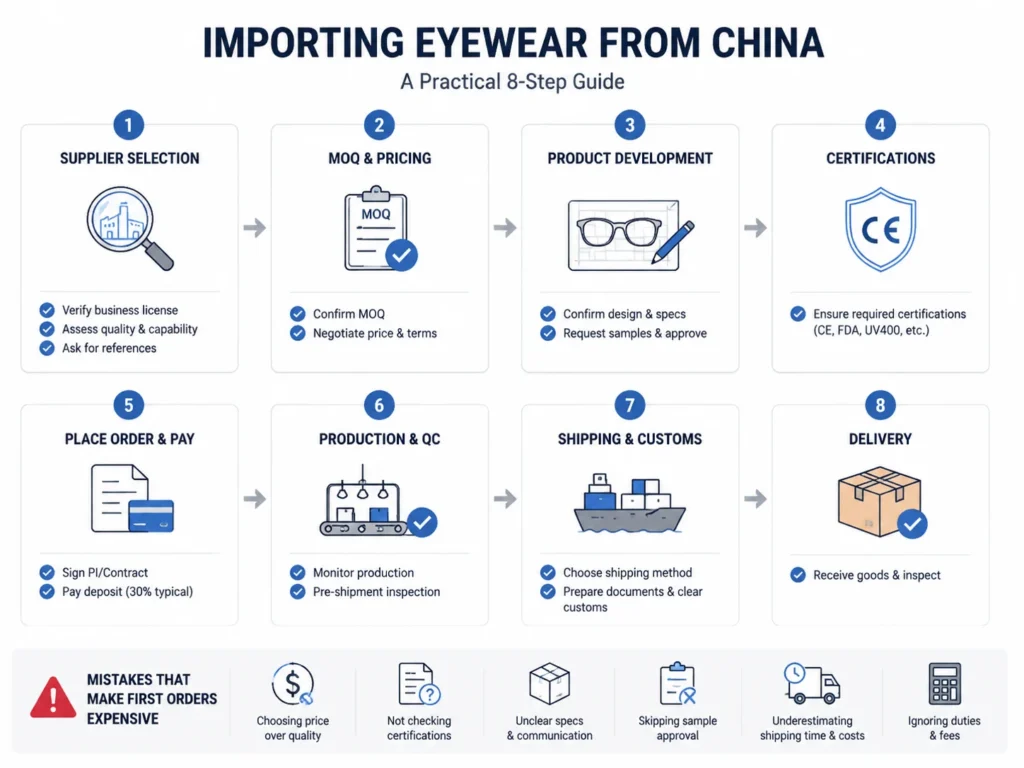
So this page is not trying to sound academic or polished for the sake of it. It is trying to make the path cleaner. We are going to talk about why China still leads in eyewear, what categories are easiest to import, how to read a supplier more carefully, where MOQ usually comes from, what the development sequence really looks like, and which mistakes still catch buyers who were sure they were being careful.
That is also why this is a commercially valuable topic, not a vanity blog post. The phrase “how to import eyewear from China” usually comes from a buyer who is comparing factories, checking risk, or trying not to waste money on the wrong first order. That reader does not need fluffy sourcing theory. They need something that sounds like it came from the factory side, after enough orders went smoothly and enough weak ones went off course.
Why Import Eyewear From China?
People usually start here with one blunt question: why China and not somewhere else? Fair question. If you are going to carry supplier risk, freight risk, and quality risk, you want a better answer than “because everyone does it.”
Competitive Pricing
Yes, China can be price-competitive. But that is too shallow to be useful by itself. The real advantage is that buyers can often land at a workable cost without stripping the product down so far that it becomes painful later. A cheap quote is easy to find in almost any market. A usable quote, with decent finish, sensible packaging, stable materials, and a supplier who still communicates properly after deposit, is another thing entirely.
Mature Supply Chain
An eyewear order always starts pulling on side issues. One hinge tone is slightly off. A pouch size needs adjusting. A temple logo process looks weak in hand. The insert is not holding the frame well enough in the box. In a mature supply chain, those moments are annoying but manageable. In a weak one, every adjustment becomes a fresh negotiation. That is one reason buyers who are building more stable manufacturing programs still keep China high on the list. The surrounding supply web is already used to this kind of back-and-forth.
Large Product Selection
You can also build category breadth here without rebuilding your whole sourcing map every year. That matters more than many buyers admit. It is one thing to source a single sunglasses line. It is another to support fashion sun, reading glasses, optical, safety, and kids product inside one broader buying strategy.
OEM and Private Label Support
A lot of buyers do not really know on day one whether they need full OEM or just a cleaner private label route. They know they want the product to feel more like their own than plain stock, but they do not want to fund complexity for ego alone. China tends to handle that middle ground well. If you need a true custom sunglasses program or a more measured private label eyewear setup, you can usually find suppliers who understand the difference.
Export Experience
This part matters more than people realize. One factory sends a clean packing list, flags delay early, and asks the right questions before production goes too far. Another one stays cheerful until timing slips, then goes oddly quiet. That difference is not cosmetic. When buyers talk about a strong china eyewear manufacturer, they are often describing export maturity as much as production skill.
Types of Eyewear You Can Import
One of the reasons China is useful to importers is simple category range. You do not need to treat every eyewear product the same way, but you can source all of them inside a market that already understands the category logic.
Sunglasses
Sunglasses are usually the easiest entry point, especially for fashion brands, distributors, online sellers, and seasonal programs. If your focus is lifestyle, sports, polarized, or retail-ready sunwear, a dedicated sunglasses manufacturer will usually make the conversation faster and less fuzzy.
Reading Glasses
Reading glasses sound simple until assortment, power range, comfort consistency, and packaging logic start affecting the deal. A category-focused reading glasses manufacturer is usually better equipped for that than a generic factory trying to cover everything with the same process.
Safety Glasses
Safety eyewear changes the tone of the sourcing discussion. The product is more application-driven, and compliance pressure tends to arrive earlier. If you are working in that area, begin with a dedicated safety glasses manufacturer rather than stretching a casual fashion supplier into a role it does not really own.
Optical Frames
Optical frames push fit, hinge feel, finish, and repeatability closer to the center. Buyers in this category are usually less forgiving about small inconsistencies, and rightly so. If optical is part of the plan, a proper optical frames manufacturer is usually the safer place to start.
Kids Eyewear
Kids eyewear brings its own set of worries: safer material choices, different fit expectations, color preferences, and sometimes tighter compliance questions. If that is your lane, work with a supplier that already knows it, such as a kids eyewear manufacturer, rather than teaching a general supplier on your live order.
How to Find a Reliable Eyewear Manufacturer
A weak supplier can look completely respectable in a PDF. Nice wording. Tidy workshop photos. A smooth sales tone. Then the sample arrives off-tone, the answers get slower, and suddenly the order feels heavier than it should. That is why this part matters so much. Reliability is not a sentence on a homepage. It is what the supplier feels like once real decisions start landing.
Verify Factory Background
Start with the basic question buyers often dodge because they are excited by the quote: who are you actually speaking to? A manufacturer, a trading company, or some hybrid structure? None of those automatically kills a deal, but they do change what the conversation means and how much visibility you really have. Ask for workshop photos, process explanation, export markets served, and something more useful than polished lobby shots. That is why a supplier’s factory profile matters. You are not just satisfying curiosity. You are reducing blind spots.
Review Certifications
Do not leave compliance questions until after the commercial side feels emotionally settled. That is how buyers talk themselves into bad positions. If your market needs testing or documentation, ask early whether the supplier can support it in a way that is organized and believable. A sensible starting point is to review the supplier’s approach to certificates and compliance support, then push one step deeper: do those files really connect to the product you want, or are they simply there to calm you down?
Request Samples
When the sample box arrives, do not only stare at the front shape. Look at how the frame was packed. Look at whether the logo feels intentional or rushed. Open the temples. Check whether the hinge feel matches what was promised. See whether the supplier followed small instructions or quietly replaced them with their own guess. Samples are the moment when a nice quote has to become a real product in your hand.
Check Production Capacity
Capacity is not a bragging number to drop into chat. It is whether the supplier can handle your order size, your launch window, your category mix, and your repeat pattern without sounding confident first and improvising later. I would rather work with a factory that understands its own limit than one that promises everything and starts negotiating reality after deposit.
Inspect Quality Control
Ask who checks incoming materials, who signs off the first pieces on the line, how bad trays are isolated, and what happens when production starts drifting. If the answer turns vague here, that tells you something. A decent supplier should be able to explain its quality control process like a working routine, not like a slogan.
And watch how they handle bad news. This matters a lot. A reliable factory is not one where nothing ever goes wrong. It is one where, when something does go wrong, you get a clean explanation instead of a soft blur of excuses. Buyers remember that. Especially the ones who have already had one supplier vanish into polite silence at exactly the wrong moment.
Practical note: if a supplier cannot explain how mistakes are prevented, you should assume you may be asked to absorb those mistakes later through delay, rework, or confusion.
Understanding MOQ Requirements
MOQ is often where the first bit of optimism gets knocked back into shape. Buyers hear the number and assume the supplier is being difficult. Sometimes the supplier is being difficult. But often the number is tied to things the buyer cannot see yet: material setup, logo handling, color planning, packaging changes, and line efficiency. Small semi-custom orders can consume a surprisingly large amount of attention.
OEM MOQ
Full OEM usually carries the highest MOQ because the factory is not only assembling goods. It is aligning molds, engineering time, material decisions, sample work, and production planning. If you want a true custom sunglasses project, expect MOQ to reflect that weight.
Private Label MOQ
Private label MOQ is often lower than OEM because the base product may already exist. But it still has to absorb logo setup, packaging changes, and sometimes color or trim adjustments. A real private label eyewear program sits in the middle: less demanding than OEM, less flexible than simple stock.
Wholesale MOQ
Wholesale MOQ can be easier for buyers who want speed, assortment, and less development friction. If that is your direction, check how the supplier handles bulk sunglasses orders and whether mixed styles, mixed colors, or pack rules change the commercial picture.
Ready Stock MOQ
Ready stock usually offers the lowest entry point because the product is already made or already planned. For buyers testing a market, watching sell-through carefully, or simply trying to get moving without overcommitting, a ready stock sunglasses route can make a lot of sense.
The better question is rarely “can you go lower?” It is “what breaks or changes if the quantity changes?” Maybe it is price. Maybe it is color choice. Maybe it is the quality of packaging you can get. Maybe it is whether the supplier treats the job like a proper live project or like an awkward favor. That is the conversation worth having.
Product Development Process
A lot of stress in importing comes from not knowing what stage the order is really in. Buyers hear many moving parts at once and the whole project turns into fog. It gets easier once the process is laid out plainly. A good supplier should be able to walk through it without drama and without sounding like the complicated parts are being edited out.
Concept
The project starts with a brief, but not the kind of brief people pretend is useful when it is still full of vague adjectives. The real starting point is category, target price, market, quantity, and one mildly uncomfortable question: how custom does this actually need to be? If that answer stays fuzzy, the factory will fill in blanks for you, and buyers rarely enjoy the version chosen on their behalf.
Sampling
After the concept is clear, sampling turns the idea into something you can judge with less imagination and more honesty. Frame shape, material feel, lens tone, logo position, packing approach, small risks around hinge feel or finish, all of that starts becoming visible. A good sample reduces doubt. A weak sample expands it.
Approval
This is where buyers talk themselves into trouble. If the sample is wrong, it is wrong. Approving it because the launch calendar feels uncomfortable does not make the problem smaller. It simply moves the problem to a more expensive stage. Factories with steadier manufacturing discipline usually push to close this properly before volume begins, because they know how ugly a weak approval becomes later.
Mass Production
Once approval is genuinely locked, the order becomes a production job instead of a design conversation. Materials get committed. Line time gets allocated. Accessories get matched. Packing starts to matter much more. This is where earlier discipline pays off. A confused project does not become cleaner just because the ship date is closer.
Shipping
After production and final checks, the order moves into export handling, freight booking, document preparation, and final delivery. From the outside this can look like a logistics stage only. It is not. Wrong labels, weak cartons, and missing paperwork can still damage the order even when the goods themselves are acceptable.
Eyewear Certifications Explained
I would be careful with this part because it is where a lot of eyewear content turns into empty name-dropping. The useful question is not which abbreviation sounds impressive. It is what your market actually expects, and whether the supplier can support that expectation with the right product and the right documentation.
CE
CE-related expectations come up often for European distribution. Buyers should confirm what is relevant for the category in front of them and whether the supplier can connect that support to the actual product being shipped, not to a nearby cousin.
FDA
For U.S.-bound projects, buyers often ask about FDA-related issues, especially around sunglasses and product claims. Again, the point is not to collect labels casually. It is to understand what the market and the product actually require.
ANSI
ANSI matters more often when safety or performance-sensitive use is involved. If safety eyewear is part of your plan, this belongs early in the conversation, not near the end.
UV400
UV400 is a familiar commercial phrase, but buyers should still ask what the supplier means by it and how that claim is backed up. It is easy to say “UV400” in sales language. Better suppliers explain how the claim connects to the product and to the relevant records.
CPSIA
CPSIA may matter where children’s products are involved. If kids eyewear is part of the order, bring that up early instead of treating it like a shipping-week detail.
The cleaner move is to review the supplier’s certification support page, then drag the discussion back to the real SKU in front of you. Exact model. Exact market. Exact packaging claim. Broad compliance talk feels productive, but it wastes time if it is not tied to an actual product decision.
Shipping Methods for Eyewear
Shipping looks like a logistics topic until the goods are finished and the money is already committed. Then it becomes personal. By that point, the wrong freight choice does not just hurt the spreadsheet. It can hurt a launch, a replenishment window, or a relationship with a customer waiting for stock. That is why shipping method choice has to match order size, urgency, carton volume, and your real tolerance for delay.
Express Shipping
Express usually makes sense for samples, urgent replenishment, and smaller orders where speed matters more than freight efficiency.
Air Freight
Air sits in the middle for many buyers. Faster than sea. More scalable than express. Still expensive enough that it should be chosen deliberately, not emotionally.
Sea Freight
Sea is often the most economical route for larger orders, but it rewards planning and punishes denial. If your launch schedule is already late, sea freight will not save you.
Rail Freight
Rail can be worth looking at on certain routes where buyers want a middle option between time and cost. It is not for every market, but it does come up.
| Method | Cost | Speed |
|---|---|---|
| Express | High | Fast |
| Air | Medium | Fast |
| Sea | Low | Slow |
| Rail | Medium | Medium |
When people ask about eyewear shipping costs, they usually do not need a generic sentence. They need to understand how freight choice interacts with launch pressure, reorder rhythm, carton volume, and cash tied up on the water or in the air.
Import Duties and Taxes
I am not going to put static duty numbers in a page like this, because that is how bad content gets mistaken for safe advice. Customs treatment changes. Local interpretation changes. Product details matter. Material composition matters. Declared value structure matters. A rate somebody copied half a year ago is not a sourcing strategy.
USA
If you are importing into the United States, check local customs regulations and work with your broker or customs advisor before the order ships. Do not wait until the cartons are already moving.
Europe
For Europe, check local customs regulations and market-specific handling expectations, especially where compliance paperwork and product classification start touching each other.
UK
For the UK, the same rule applies: check local customs regulations instead of building your cost model around something you read in an old post or heard in a casual chat.
Australia
Australian buyers should also check local customs regulations because landed cost is never only the supplier price plus freight.
If you want a real landed-cost picture, build it from the ground up: product cost, packaging, freight, local charges, duties or taxes where relevant, and delivery after arrival. Buyers make bad margin decisions when they fall in love with ex-factory price and treat everything else like a detail for later.
Common Mistakes When Importing Eyewear
Choosing Based Only on Price
Cheap quotes have a way of charging interest later. Weak materials. Loose finishing. Bad pouches. Thin cartons. A supplier who answers quickly while selling and slowly once the order becomes real. If price is the only filter, the missing cost usually shows up somewhere more annoying.
Skipping Sample Approval
This one causes more pain than it should. A buyer knows the sample is not quite right, tells themselves the factory understands the intention, and approves it anyway because the schedule feels tight. Then production follows the approved sample more honestly than the buyer expected. That is not bad luck. That is weak approval doing exactly what weak approval does.
Ignoring Certifications
Compliance questions asked late are almost always more expensive than the same questions asked early. At the start, they feel mildly annoying. Near shipment, they can become blockers.
Weak Packaging
Packaging is not only a branding surface. It is protection, presentation, warehouse confidence, and sometimes the difference between a smooth arrival and cartons that already feel suspect before anyone opens them.
Unrealistic Lead Time Expectations
Factories can move quickly when the order is clear. They do not move gracefully when artwork keeps changing, the sample is only half-approved, and the freight plan is still floating in the air. I have seen buyers ask for speed while feeding the project one new uncertainty every few days. That rarely ends the way they hope.
Worth remembering: most importing problems are not mysterious. They usually begin with rushed decisions made early, then defended too long.
Ready Stock vs OEM Production
This comparison is worth making early, because a lot of confusion disappears once you admit what kind of order you actually want. Some buyers want speed and lower risk. Some want distinction badly enough to live with more complexity. Trouble starts when the language says one thing and the budget or timeline says another.
| Feature | Ready Stock | OEM |
|---|---|---|
| MOQ | Lower | Higher |
| Lead Time | Faster | Longer |
| Customization | Limited | Full |
Ready stock sunglasses make sense when what you really need is speed, lower opening risk, and a cleaner way to test the market. There is nothing unambitious about that. Sometimes the smartest first move is the one that gets product moving without forcing the buyer and factory to pretend deep trust already exists.
OEM development makes sense when the brand has a clear point of view and enough conviction behind it to justify a slower, more expensive path. It can absolutely be worth it. But it should come from a real commercial reason, not from the feeling that every serious brand must start with custom mold on principle.
The real mistake is mismatch. Asking for OEM treatment on stock-friendly quantity. Expecting stock-like speed from a project still changing shape. Or convincing yourself the brand needs full uniqueness when what it really needs is a cleaner first order and fewer surprises.
For many buyers, the wiser route is staged. Start lower risk. Watch how the supplier communicates. See how the goods arrive. Check whether quality holds from sample to carton. Then decide if the relationship has earned the right to carry a more complex OEM program.