
Safety Glasses
Manufacturer
ANSI & EN166 certified safety glasses manufacturing for industrial brands, PPE distributors, and wholesale buyers.
OEM protective eyewear solutions built to the standards that actually matter in the markets where safety eyewear gets sold, inspected, and used.
Safety Eyewear Is a Different
Kind of Manufacturing
Safety glasses are not sunglasses with a different name. The materials, the testing protocols, the tolerances, the documentation — all different. A factory that adds "safety glasses" to a product page without understanding ANSI Z87.1 high-impact requirements or the distinction between EN166 optical classes is not actually a safety eyewear manufacturer.
We've been producing certified safety eyewear for over a decade. Our buyers include PPE brands selling into US distribution channels where ANSI certification is non-negotiable, European industrial suppliers working to EN166 Class 1 optical requirements, and Amazon PPE sellers who've learned the hard way what happens when test reports don't hold up to scrutiny.
We provide accredited lab test reports with every certified model. Third-party audits through SGS or Bureau Veritas can be arranged on request. The documentation you receive is the same documentation that goes in front of a buyer's compliance team — not a factory-issued certificate.
We use accredited third-party labs for ANSI and EN166 testing. The report names the lab and the test date. It will hold up to a compliance review.
Certification requirements affect material selection and mold design. We confirm the full cert scope before production begins — not after the bulk order is ready to ship.
Logo, color, packaging — all customizable. But customization on a certified model goes through engineering review to confirm it doesn't affect the tested performance.
Industrial Safety Eyewear
Manufacturing Solutions
Six product lines within our safety eyewear range. Each has its own certification path, material requirements, and typical buyer profile. Most OEM programs start with one or two models before expanding.

Anti-Impact Safety Glasses
Polycarbonate lenses rated for high-impact and basic-impact performance. ANSI Z87.1 H+ or Z87+ depending on the model. Used in construction, manufacturing, and general industrial environments where flying debris is the primary hazard.
View Models →
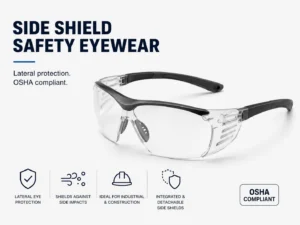
Side Shield Safety Eyewear
Wraparound and side-shield configurations for environments requiring lateral eye protection. Popular in industrial and construction applications where OSHA compliance mandates lateral coverage. We produce both integrated and detachable side shield designs.
View Models →
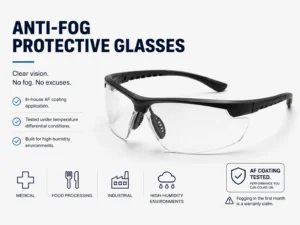
Anti-Fog Protective Glasses
Anti-fog coating is critical in medical, food processing, and high-humidity industrial environments. Our AF coating is applied in-house. Performance is tested under temperature differential conditions — not just labeled. A lens that fogs up in the first month is a warranty claim waiting to happen.
View Models →
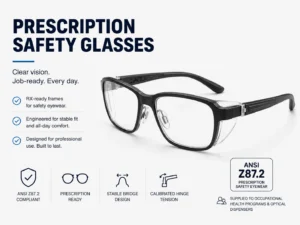
Prescription Safety Glasses
RX-ready safety frames meeting ANSI Z87.2 for prescription safety eyewear. Correct lens retention geometry, stable bridge dimensions, and hinge tension calibrated for daily professional use. Supplied to occupational health programs and optical dispensers serving industrial clients.
View Models →
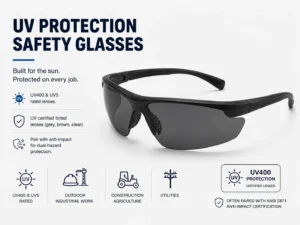
UV Protection Safety Glasses
UV400 and UV5 rated lenses for outdoor industrial work — construction, agriculture, utilities. Tinted safety lenses (grey, brown, clear) with UV certification. Often paired with anti-impact certification for dual-hazard applications.
View Models →
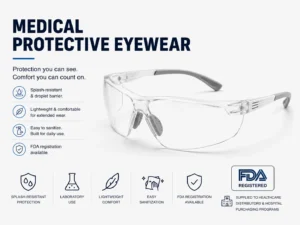
Medical Protective Eyewear
Splash-resistant and droplet-barrier protective glasses for medical and laboratory use. Lightweight, comfortable for extended wear, easily sanitized. FDA registration available. Supplied to healthcare distributors and hospital purchasing programs.
View Models →
Custom Safety Glasses
OEM Services
Most safety glasses OEM buyers come to us with one of two situations. Either they have a certified product they're currently buying elsewhere and want to switch to a more reliable manufacturer — in which case we work from their existing test reports and replicate the spec. Or they're developing a new product line and need us to handle the certification process from the start.
- Logo printing & branding — temple printing, laser marking, and packaging customization that goes through engineering review to confirm cert compliance isn't affected
- Lens coatings — AS (anti-scratch), AF (anti-fog), AR (anti-reflective), tinted, UV400; coating combinations confirmed against certification scope before production
- Frame materials — polycarbonate, TR90, TPU, nylon; material selection based on impact classification, weight requirements, and target market
- Packaging — retail hang-tag, poly bag, bulk carton, case-pack for B2B distribution; includes test report insert and CE/ANSI markings where required
- Certification assistance — we coordinate lab testing, prepare the technical file for CE, and advise on which certifications apply to your target market
- Custom mold development — new frame geometries developed to spec; we confirm impact performance at prototype stage before committing to production tooling
Certification doesn't get retrofitted
One thing buyers learn after their first safety glasses program: you can't customize a certified product and assume the certification still applies. If the temple changes, the color changes to something that affects lens optical properties, or the coating spec changes — the model may need retesting.
We flag these issues before production starts. It's the one area where we'll slow down the timeline rather than proceed and hope for the best. A failed compliance inspection costs more than a two-week delay.
We've guided buyers through the ANSI and EN166 certification process from scratch. If this is your first certified safety product, we'll walk through what the process involves before you commit to anything.
Discuss Your Project View our certifications →Safety Eyewear Materials
& Lens Technologies
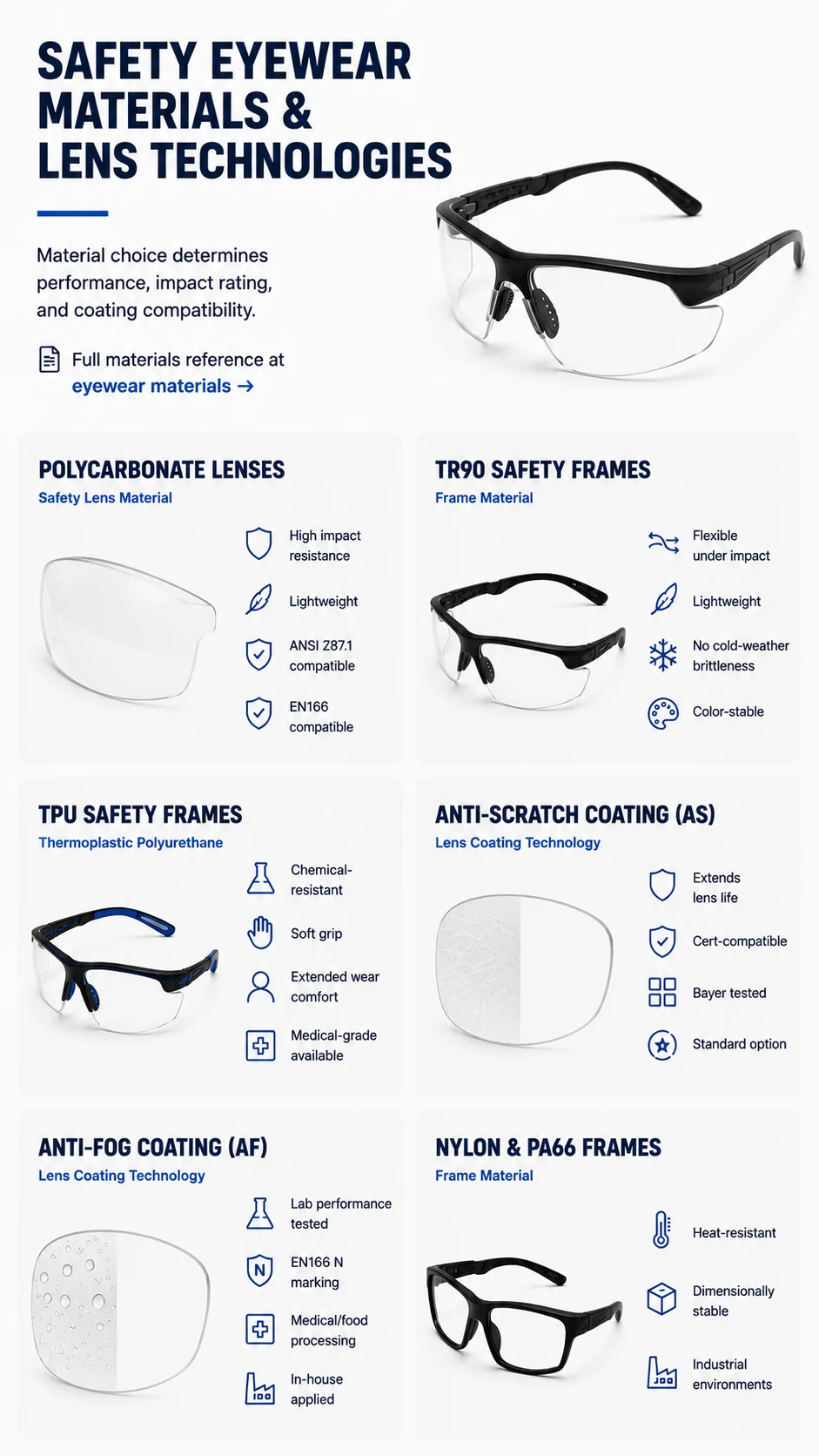
Material selection in safety eyewear isn't just about cost and weight — it determines which impact classifications the product can reach and what coatings are compatible. We advise on this before the spec is locked. Full materials reference at eyewear materials →
Polycarbonate Lenses
Safety Lens Material
The standard for certified safety lenses. Naturally impact-resistant without additional treatment — significantly more so than CR-39 or glass. We use optical-grade PC that meets the impact transmission requirements for ANSI Z87.1 high-impact and EN166 F/B impact ratings. Every batch is tested, not just sampled.
TR90 Safety Frames
Frame Material
Flexible, lightweight, and resistant to stress cracking under impact. TR90 doesn’t shatter the way rigid plastics can — which matters in high-impact applications. Good for wraparound safety styles. Lower processing temperature than nylon which improves dimensional stability in the mold.
TPU Safety Frames
Thermoplastic Polyurethane
Softer than TR90, better grip on the face, excellent chemical resistance. Used in applications where the frame contacts the face for extended periods — medical, food processing, lab environments. Rubber-feel temples and nose bridges are typically TPU. Doesn’t absorb chemicals the way rubber does.
Anti-Scratch Coating (AS)
Lens Coating Technology
Standard hard coat applied to PC lenses. Extends functional lens life in harsh environments. We test coating adhesion using cross-hatch and tape tests, and abrasion resistance under Bayer or Taber test protocols. AS coating is compatible with most certification paths and doesn’t affect optical class rating.
Anti-Fog Coating (AF)
Lens Coating Technology
Hydrophilic coating that draws moisture into a uniform layer rather than allowing droplet formation. We apply AF in-house and test under temperature differential conditions (warm lens, cold environment) to verify the coating performs. AF coating compatibility with EN166 N marking requires confirmation per model — we check this before production.
Nylon & PA66 Frames
Frame Material
Nylon (polyamide) is durable, dimensionally stable, and handles high-temperature environments better than most thermoplastics. PA66 is the standard for industrial safety frames that need to maintain geometry under heat stress — welding environments, foundry, and high-temperature manufacturing applications.
Here goes your text … Select any part of your text to access the formatting toolbar.
Safety Eyewear
Quality Control Process
Safety eyewear QC is not the same as fashion eyewear QC. The tests are standardized, the pass/fail criteria are defined by the certification standard, and a failed lot doesn’t get relabeled — it gets scrapped or sent back to production. Our QC process is designed around those standards, not around passing visual inspection. Full detail at quality control →
Impact Resistance Test
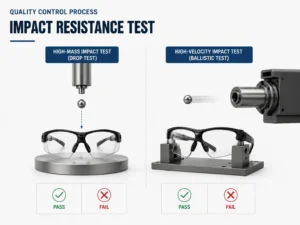
High-mass and high-velocity impact tests per ANSI Z87.1 and EN166 requirements. Steel ball dropped from defined height and fired at defined velocity against the lens. Pass/fail based on lens retention and no fragmentation.
Drop Ball Test
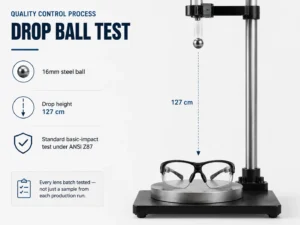
16mm steel ball dropped from 127cm directly onto the lens. Standard basic-impact test under ANSI Z87. Every lens batch tested — not just a sample from each production run.
Lens Optical Clarity
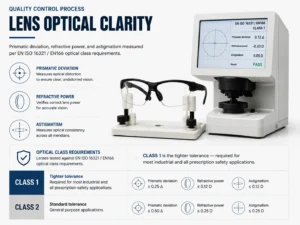
Prismatic deviation, refractive power, and astigmatism measured per EN ISO 16321 / EN166 optical class requirements. Class 1 is the tighter tolerance — required for most industrial and all prescription safety applications.
Hinge Durability Test
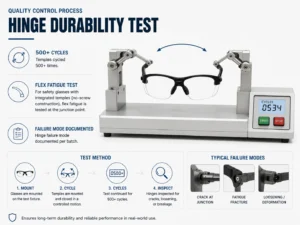
Temples cycled 500+ times. For safety glasses with integrated temples (no-screw construction), flex fatigue is tested at the junction point. Hinge failure mode documented per batch.
UV Protection Testing
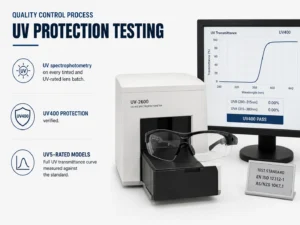
UV spectrophotometry on every tinted and UV-rated lens batch. UV400 protection verified. For UV5-rated models, full UV transmittance curve measured against the standard.
Anti-Fog Performance
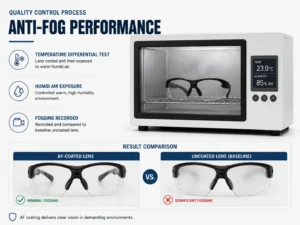
AF-coated lenses tested under temperature differential conditions — lens cooled and then exposed to warm humid air. Fogging recorded and compared to baseline uncoated lens.
How We Work
Safety Glasses
Manufacturing Process
Eight stages. Each has a checkpoint. Safety eyewear production has less margin for process shortcuts than fashion eyewear because the performance spec is defined by a certification standard — not by a buyer’s subjective approval. See the full production detail at eyewear manufacturing →
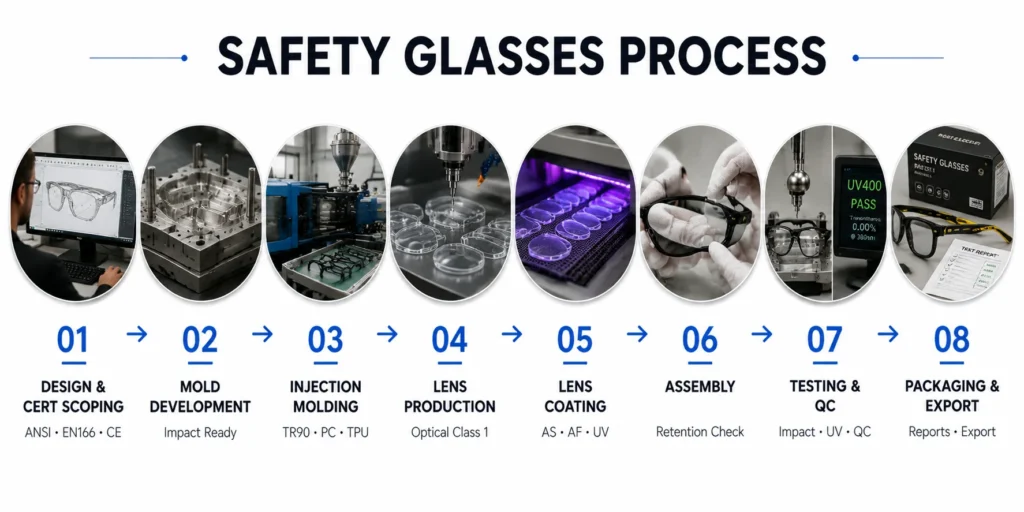
Design & Cert Scoping
→Frame geometry, lens dimensions, and intended use reviewed. Certification path (ANSI, EN166, CE, FDA) confirmed and documented before any materials are specified.
Mold Development
→Mold design verified against impact classification requirements. Wall thickness, lens retention geometry, and frame-to-lens contact area checked against the relevant standard before steel is cut.
Injection Molding
→Frame injection in TR90, TPU, nylon, or polycarbonate. First-article inspection against spec before the production run proceeds. Dimensional check on every batch, not just first-off.
Lens Production
→Polycarbonate lenses cut from certified-grade PC sheet or injection-molded. Optical class checked at this stage — refractive power and prismatic deviation measured per EN ISO 16321 tolerances.
Lens Coating
→AS, AF, AR, UV coatings applied in-house. Coating adhesion verified. Anti-fog performance tested under temperature differential before assembly. Coating combinations confirmed against certification scope.
Assembly
→Lens insertion and retention force checked. Hinge assembly and torque verified. Side shields fitted where specified. Logo and markings applied. ANSI/EN166 lens markings confirmed before final assembly.
Testing & QC
→Impact testing, drop ball, optical clarity, UV verification, anti-fog performance. Batch defect rate tracked. Any batch exceeding threshold triggers a production hold and root-cause review before release.
Packaging & Export
→Packed with test report insert, CE/ANSI markings on packaging, barcode and labeling to your spec. Export documentation, certificate of origin, and test reports prepared. Shipped with tracking.
Safety Eyewear Certifications
Every safety eyewear market has a governing standard. Some buyers know exactly which certifications they need. Others know the market they're selling into but haven't worked through which standard applies. We can advise on both — but the short version is below.
US Safety Standard
The American National Standards Institute standard for occupational and educational personal eye and face protection. Covers impact resistance (basic and high-impact), optical quality, coverage, and lens markings.
European Safety Standard
The European standard for personal eye protection, replacing national standards across EU member states. Defines optical classes (1 and 2), protective markings (impact codes B/F/S/A), and additional protections (N for anti-fog, K for anti-scratch).
EU Market Access
CE marking is required for all PPE sold in the EU and EEA. For safety glasses, CE is based on compliance with EN166 (and EN ISO 16321 series, which supersedes EN166 in stages). We prepare the technical file for CE and work with notified bodies where required under the EU PPE Regulation 2016/425.
US Medical & Impact Eyewear
The FDA regulates impact-resistant lenses under 21 CFR 801.410. For medical protective eyewear, FDA registration and 510(k) clearance paths depend on intended use. We hold FDA facility registration and can advise on the documentation path for your specific product.
Industries We Serve
Safety eyewear requirements vary significantly by industry. The hazard profile for a construction site is different from a chemical laboratory or a medical ward. We manufacture for all of them — and we understand the specific requirements each application brings to the product spec.
Construction
High-impact rated, wraparound coverage, UV protection for outdoor use. ANSI Z87.1 and EN166 standard requirements.
Medical
Splash-resistant, anti-fog coated, comfortable for extended wear. FDA registration. Easily sanitized materials.
Laboratory
Chemical splash resistance, optical Class 1 clarity, comfortable bridge fit for all-day wear. EN166 4 (liquid droplet) rated.
Industrial Manufacturing
Impact-resistant, anti-scratch coated, side shield protection. Designed for high-use environments where replacement cycle matters.
Automotive
Impact protection, UV rating for outdoor work, tinted options for welding inspection. ANSI Z87.1 compliant.
Manufacturing
Heat-resistant frames (PA66/nylon) for high-temperature environments. Impact-rated lenses. High-volume supply capacity.
Chemical
Chemical splash protection (EN166 3 rated), full-frame seal options, TPU frames for chemical compatibility.
Logistics & Warehousing
Lightweight, high-impact basic rating, comfortable for all-day wear. Cost-effective for high-volume replacement programs.
What Actually Matters
in a Safety Eyewear Factory
15+ Years in Certified Safety Eyewear
Not 15 years making eyewear and offering safety glasses as a side category. We've built ANSI and EN166 programs from the ground up and know where the certification process has friction points before you hit them.
ANSI / EN166 Process Experience
We've guided buyers through both certification paths multiple times. We know which labs to use, how to structure the technical file for CE, and what documentation an Amazon PPE listing or EU regulatory audit is going to ask for.
Low MOQ for Certified Products
500 pieces per certified model — lower than most factories running safety eyewear. We've structured our production around making certification-grade products accessible to mid-size PPE brands, not just high-volume buyers.
Fast Sampling on Existing Models
7–14 days for samples on existing certified models. New mold development adds time. We won't rush a new mold through development — impact testing on a new geometry has to be done properly, not optimistically.
Stable, Documented QC
QC records are maintained per batch and available to buyers on request. Defect rate data, impact test results, coating performance — documented, not just claimed. Third-party audit welcomed.
Global Export — Documentation Handled
We've exported to 60+ countries including markets with the strictest PPE import requirements. Export documentation, CE technical files, test reports for customs, FDA facility registration — we handle all of it before your shipment loads.
Safety Eyewear Manufacturing Guides
ANSI Z87.1 vs EN166: Which Standard Applies to Your Market?
A practical breakdown for safety eyewear buyers who need to understand which certification path applies before placing an OEM order.
MaterialsBest Materials for Safety Eyewear Frames and Lenses
Polycarbonate, TR90, TPU, nylon — what each material actually does in a safety application, and when each makes sense for your product spec.
CoatingsAnti-Fog Lens Coatings for Safety Glasses: What Buyers Need to Know
Why AF coating performance varies so widely across products, how it's tested, and what to specify in your OEM brief to get a coating that actually works.
Quality ControlHow Safety Glasses Are Tested: The ANSI and EN166 Test Process Explained
Impact tests, optical class measurements, drop ball protocol — the actual tests your certified safety glasses go through before they get a marking.
OEM GuideThe OEM Safety Glasses Guide for PPE Brands and Importers
MOQs, certification timelines, tooling costs, and what the process looks like from brief to certified bulk shipment.
FAQ — Safety Glasses Manufacturing
Ready to Build a Certified
Safety Eyewear Line?
Send us your requirements — product type, target certifications, volume, and any existing test reports if this is a supplier switch. We'll come back with a real assessment within one business day.